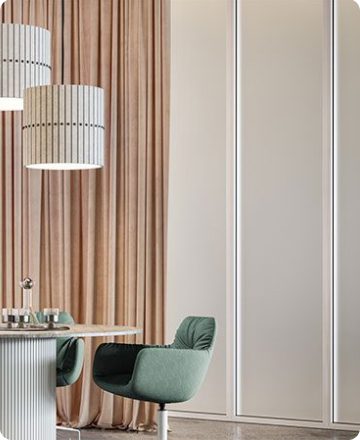
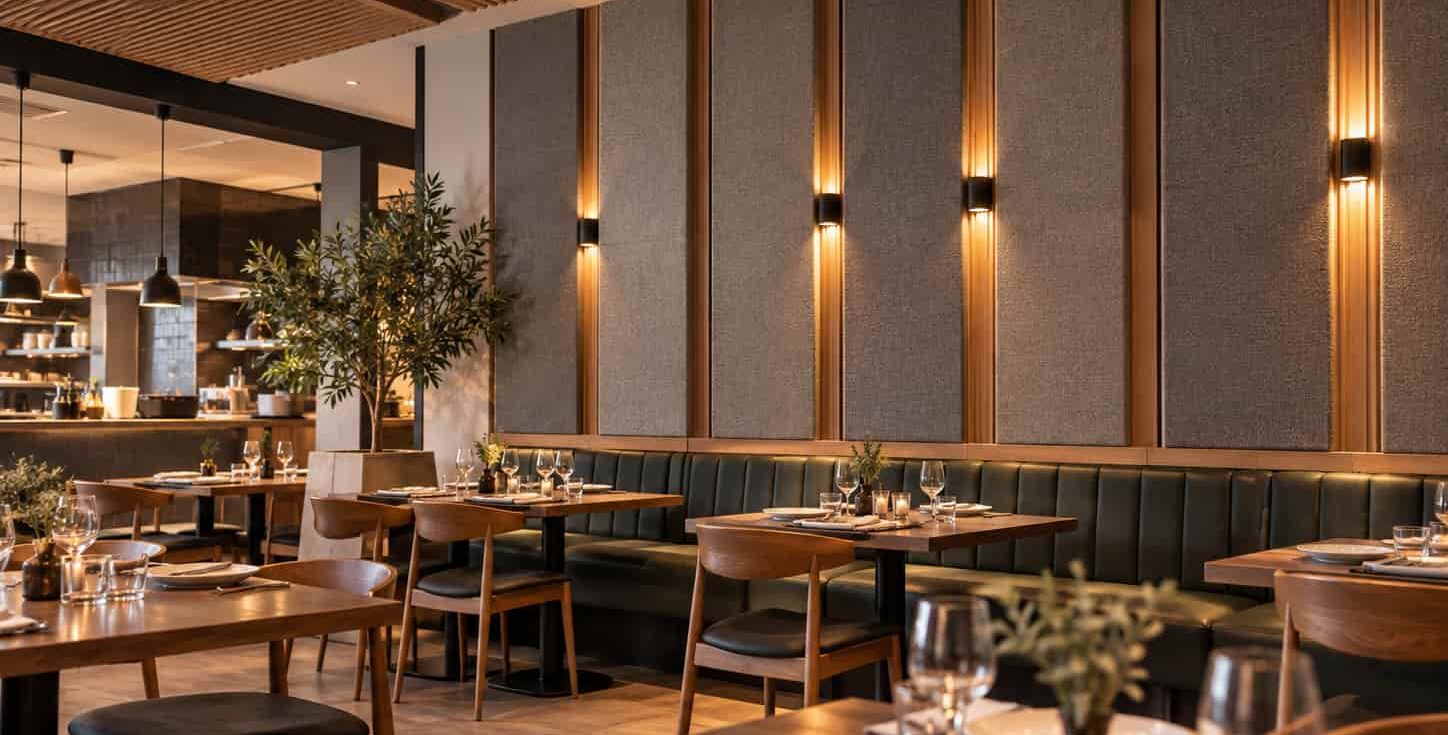

Acoustic panels help restaurants, cafés, bars and hospitality venues manage reverberation and background noise while supporting the overall interior design. The right acoustic treatment can improve speech clarity, comfort and atmosphere without compromising the visual character of the space.
Key Takeaways
- Hospitality interiors often contain hard surfaces that reflect sound and increase reverberation.
- Acoustic panels can help improve speech clarity and overall comfort for guests and staff.
- Wall, ceiling and decorative acoustic treatments can be integrated into the interior design.
- Material choice should consider acoustic requirements, appearance, durability and installation location.
- Design-led acoustic products can help venues manage sound without making the space feel overly functional.
Why Acoustics Matter in Hospitality Spaces
Restaurants and hospitality venues are designed to feel lively, but excessive noise can quickly make a space uncomfortable.
Hard finishes such as concrete, glass, tiles, timber and metal reflect sound rather than absorb it. In busy venues, conversations, music, kitchen noise and movement can combine to create high levels of reverberation.
Acoustic treatment helps reduce these reflections and can make it easier for guests to hear conversations, while also improving the working environment for staff.
Where Acoustic Panels Can Be Used
Acoustic panels can be incorporated into hospitality interiors in several ways, depending on the layout and design intent.
Common applications include:
- Feature walls
- Ceiling treatments
- Dining areas
- Bars and lounges
- Private dining rooms
- Reception and waiting areas
- Screens and partitions
Mitchell Group’s acoustic panel range includes design-led solutions for walls, ceilings and other interior applications.
Combining Acoustic Performance with Interior Design
Acoustic treatment does not need to look like a technical addition to the room.
Modern acoustic panels are available in a wide range of colours, shapes, textures and dimensional finishes, allowing designers to incorporate sound management into the visual language of the venue.
Products such as EchoPanel® can be used across decorative wall and ceiling features, while UmbraTex® provides textured acoustic surfaces for projects requiring greater visual depth and customisation.
This is particularly useful in hospitality environments where finishes contribute heavily to atmosphere and brand identity.
Choosing Acoustic Panels for Restaurants and Venues
The right acoustic solution depends on the space itself.
Project teams should consider:
- Room size and ceiling height
- Existing hard surfaces
- Number of occupants
- Background music and kitchen noise
- Wall and ceiling availability
- Required visual finish
- Cleaning and maintenance
- Installation method
Acoustic treatments can also be distributed across several surfaces rather than concentrated in one area. Combining wall panels, ceiling elements and screens or partitions can help address sound while maintaining flexibility in the interior layout.
Designing Comfortable Hospitality Interiors
Good hospitality design considers how a venue sounds as well as how it looks.
By integrating acoustic materials early in the design process, architects and interior designers can create restaurants, cafés and hospitality spaces that feel energetic without becoming unnecessarily noisy.
Mitchell Group supports architects, designers, builders and shopfitters with acoustic materials for commercial interior applications, including decorative wall, ceiling and partition solutions.
Create Better Hospitality Spaces with Acoustic Panels
Acoustic panels can help hospitality venues balance atmosphere, conversation and interior design. With options ranging from subtle sound-absorbing surfaces to highly decorative feature panels, acoustic treatment can become an integral part of the finished space.
Learn more about Mitchell Group’s experience or contact the team to discuss acoustic solutions for your next hospitality project.